
2025.04.24
Pentatricopeptide repeat protein targeting CUG repeat RNA ameliorates RNA toxicity in a myotonic dystrophy type 1 mouse model
Yamaguchi University, Osaka University, and a Kyushu University spin-off venture have announced a significant breakthrough that could lead to treatments for myotonic dystrophy, the most common inherited muscle disorder in adults.
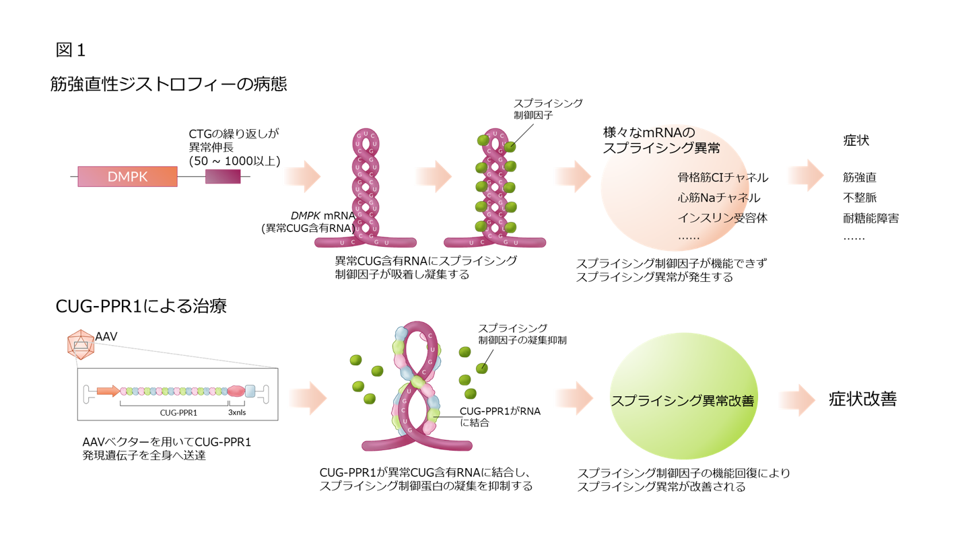
The research group developed an artificial protein, “CUG-PPR1,” which specifically binds to the abnormal RNA causing the disease by applying plant-derived RNA-binding proteins called “PPRs.” A single administration of this artificial protein to mice demonstrated significant improvement in muscle symptoms and long-term effects. Side effects were also minimized.
This CUG-PPR1 holds the potential to become the world’s first fundamental treatment for myotonic dystrophy. Furthermore, since this PPR technology can be applied to other hereditary diseases, it is anticipated as a next-generation RNA-targeted drug discovery platform.
These findings were published in Science Translational Medicine.

- Division of Advanced Genome Editing Therapy
- Masayuki Nakamori(Neurology)
- Publication:Science Translational Medicine
- Posted on: Thursday, April 17, 2025, at 3:00 AM (Japan Standard Time)
- Paper Title:Pentatricopeptide repeat protein targeting CUG repeat RNA ameliorates RNA toxicity in a myotonic dystrophy type 1 mouse model
- Author:Takayoshi Imai, Maiko Miyai, Joe Nemoto, Takayuki Tamai, Masaru Ohta, Yusuke Yagi, Osamu Nakanishi, Hideki Mochizuki, and Masayuki Nakamori
- DOI:https://doi.org/10.1126/scitranslmed.adq2005
- <Research Inquiries>
- Department of Neurology Graduate School of Medicine, Yamaguchi University
- Masayuki Nakamori
- TEL: 0836-22-2719/2713
- E-MAIL: mnakamor@yamaguchi-u.ac.jp
- <Public Relations>
- Yamaguchi University Research Institute for Cell Design Medical Science (Life Science Support Section, Academic Research Division)
- Tel: 0836-85-3065
- E-mail: sh088@yamaguchi-u.ac.jp