
2026.05.14
*Announcement* Lecturer Naomi Tominaga Selected for the JST “FOREST” Program
We are pleased to announce that Naomi Tominaga, Ph.D. (Lecturer at the Graduate School of Medicine / Research Institute for Cell Design Medical Sciences) has been selected for the “FOREST” (Fusion Oriented REsearch for disruptive Science and Technology) program by the Japan Science and Technology Agency (JST) for the fiscal year 2025.
Out of 2,217 applications submitted nationwide, 257 research projects were selected, with Lecturer Tominaga being chosen as one of the successful candidates.
The details of the research project are as follows:
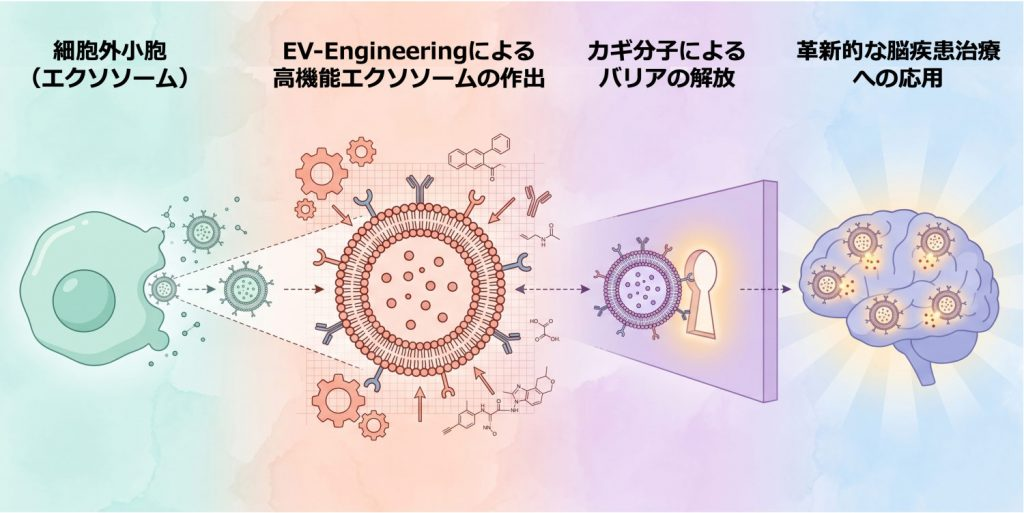
Project Title: Creation of Novel Therapeutics by Controlling Brain Barrier Function via EV Engineering
Project Overview: The greatest barrier to treating brain diseases such as Alzheimer’s disease and metastatic brain tumors is the “blood-brain barrier” (BBB), which prevents drugs from entering the brain. Currently, even promising antibody drugs are largely blocked by this barrier, severely limiting effective treatment options.
This research focuses on Extracellular Vesicles (EVs), also known as exosomes—natural nano-capsules released by cells. By applying the mechanisms of these highly biocompatible biological carriers, the project aims to establish a foundational technology to safely and temporarily regulate the blood-brain barrier. Unlike conventional methods focused on “delivering specific drugs,” this highly versatile approach aims to “open the door to the brain for all drugs,” potentially bringing a paradigm shift to drug discovery for brain diseases.
Our university will continue to actively support “FOREST” (Fusion Oriented Research for disruptive Science and Technology) to generate research outcomes that contribute to society, including this newly selected project.
What is the FOREST Program?
The FOREST program, established by the Japan Science and Technology Agency (JST), aims to promote “FOREST research” that leads to disruptive innovation through diversity and fusion, without setting specific short-term goals. To encourage free, challenging, and interdisciplinary research that transcends existing frameworks, the government provides long-term support for a period of seven years in principle (up to 10 years, following a stage-gate evaluation). This support ensures an environment where researchers can fully immerse themselves in their research activities.
Reference:
https://www.jst.go.jp/souhatsu/call/sel24.html