2026.11.09
*Announcement* Associate Professor Tsuyoshi Katsuta (Interdisciplinary Research Unit) has had his research project selected for the “Emergent Research Support Program” administered by the Japan Science and Technology Agency (JST).
Associate Professor Takeshi Katsuda of the Research Institute for Cell Design Medical Science has been selected for a new FY2026 project under the “Emergent Research Support Program” of the Japan Science and Technology Agency (JST). This call for proposals received 2,519 applications from across the country, and 243 research projects were selected. Associate Professor Katsuda is one of the selected researchers.
The selected project and its overview are as follows.
Selected Project: Elucidation of the Principles of Organ Reconstruction through Cell Replacement
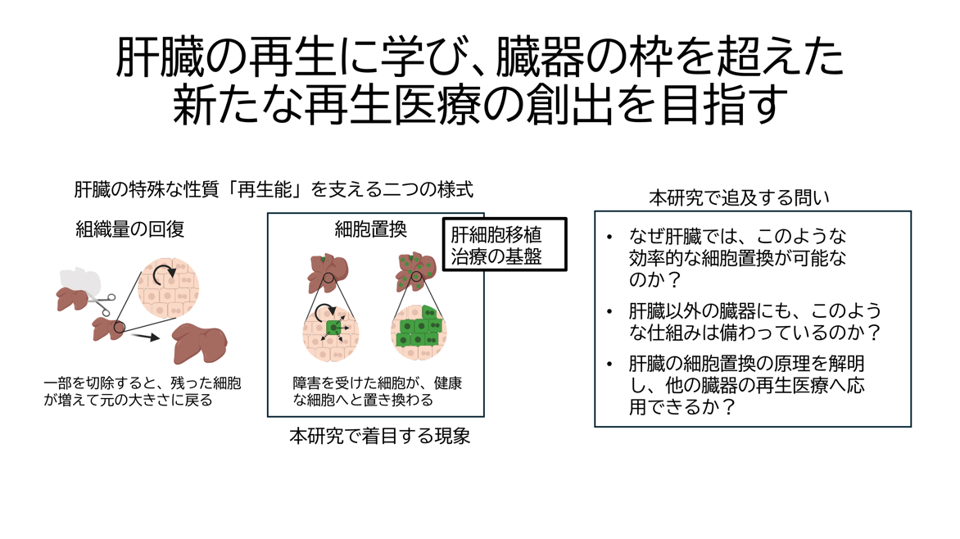
Overview: In mammals, the liver is a unique organ with a high capacity for regeneration. Even if part of the liver is resected or a large number of cells are lost due to toxins or other causes, the remaining cells proliferate to restore the organ’s size and function. However, the liver’s unique properties do not end there. The liver possesses the “cell replacement capacity” to replace damaged cells with healthier ones. In fact, animal experiments have shown that when normal liver cells are transplanted into a damaged liver, the transplanted cells proliferate and extensively replace the original cells, thereby restoring liver function. In contrast, such efficient cell replacement has not been reported in many other organs. In this study, we tackle the fundamental question: “Why is efficient cell replacement possible in the liver?” In addition to the conventional understanding of regeneration—where cells multiply to compensate for lost tissue—we aim to elucidate the mechanisms by which organs are reconstructed by focusing on the process by which existing tissue is replaced with healthy cells. Furthermore, using the insights gained from the liver as a starting point, we will explore the possibility of achieving cell replacement in other organs as well. By doing so, we aim to expand treatment options to organs where functional recovery through cell transplantation has previously been difficult, and to lay the groundwork for a new form of regenerative medicine that restores function through cell replacement without the need for whole-organ transplantation.
Our university will continue to actively support “emergent research” to generate research outcomes that contribute to society, including the research projects recently selected for funding.
About the Emergent Research Support Program…
This program is designed to promote “emergent research”—which aims to generate seeds for disruptive innovation through diversity and convergence without setting specific challenges or short-term goals. To this end, the government provides long-term support for a period of seven years in principle (up to a maximum of 10 years, subject to stage-gate reviews) for free-form, challenging, and interdisciplinary research that transcends existing frameworks, while ensuring an environment where researchers can devote themselves fully to their work.
Reference
JST Website: https://www.jst.go.jp/souhatsu/call/sel24.html